My Cloud Resume Challenge Journey — A Deep Technical Learning Experience
After several intense weeks, my Cloud Resume Challenge project is **LIVE**! This was a deep dive into full-stack cloud architecture, that pushed me far beyond theory, requiring real architecture, real automation, real problem-solving, and real deployment.
Check out the live site and source code.
- 🔗 **Live Project:** https://www.michailkakos-resume.com
- 💻 **Source Code:** https://lnkd.in/eHgdf8xD
What is the Cloud Resume Challenge?
The Cloud Resume Challenge (CRC) is a practical, end-to-end cloud project that requires you to:
- Build and host a resume website in the cloud
- Implement a serverless backend with a visitor counter
- Store data in a managed NoSQL database
- Use Infrastructure as Code
- Deploy via automated CI/CD pipelines
- Prove your cloud, programming, security, and DevOps skills in one integrated solution
It simulates the real workflows of cloud engineers and solutions architects — not just passing an exam but building something that works at production-level standards.
Why I Took Up This Challenge
Coming from a network engineering background, I wanted a project that would push me beyond networking into full cloud architecture, but I had to grow in:
- Python backend development
- Serverless event-driven patterns
- NoSQL modeling(DynamoDB)
- Terraform IaC structures
- CI/CD automation and testing
- Cloud-native observability
This project truly bridges traditional networking with modern cloud engineering.
Architecture of the Solution
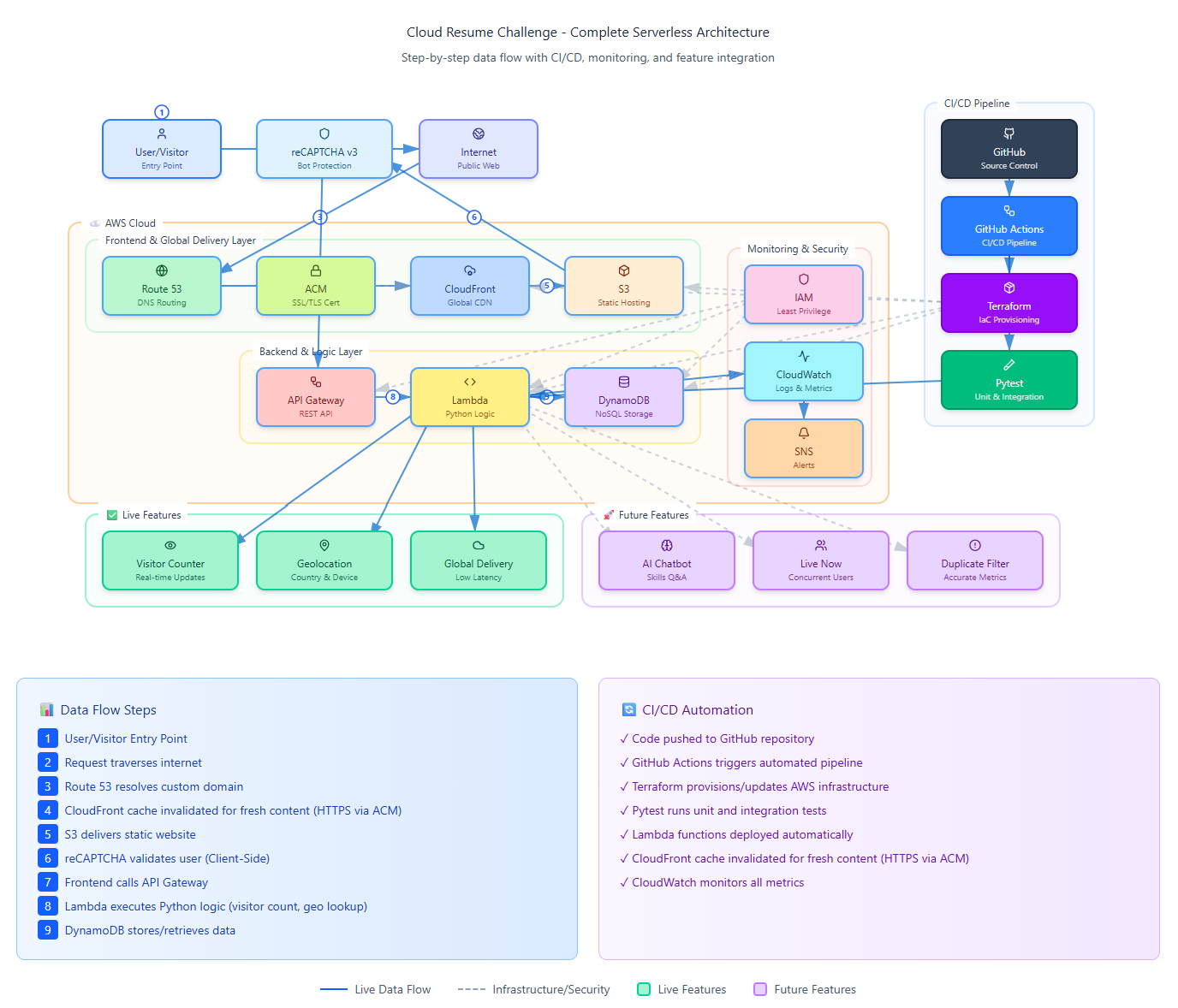
Frontend
- S3 – static hosting
- CloudFront – global CDN with caching policies
- ACM + Route 53 – HTTPS + custom DNS routing
Backend
- API Gateway (REST) – visitor request routing
- AWS Lambda (Python) – business logic, geo-lookup, idempotent updates
- DynamoDB – visitor counter + geolocation analytics
DevOps & Automation
- Terraform – fully modular Infrastructure as Code
- GitHub Actions – CI/CD with: Pytest unit + integration testing
What Were the Biggest Challenges?
- Terraform state & modularisation: Building reusable, hierarchical modules while managing state safely.
- DynamoDB conditional updates: Ensuring atomic increments during concurrent requests.
- CI/CD packaging for Lambda: Correctly bundling dependencies and tests for Python Lambda deployments.
- CloudFront invalidation automation: Ensuring new versions deploy globally without downtime.
- Data model design: Supporting visitor counting + geolocation analytics with a single-table pattern.
- Security hardening: IAM least privilege, bot protection, API throttling, and misconfiguration prevention.
Key Takeaways
- Cloud engineering requires end-to-end thinking, not just service knowledge
- CI/CD transforms development velocity and consistency
- Serverless simplifies ops but requires good design and testing
- IaC is essential for modern infrastructure reproducibility
- Logging, monitoring, and metrics matter from day one
- The best learning happens by building something real
Final Thoughts
This challenge wasn’t just a project — it was a hands-on simulation of real cloud engineering work:
It helped me push beyond tutorials to design a system that:
- Scales globally
- Deploys automatically
- Operates securely
- Produces real analytics
- Demonstrates practical, job-ready cloud engineering skills
I highly recommend it for anyone seeking real-world experience.